The Four Sources of Operational Drag.
The four structural causes behind most operational problems, and how to recognise them before they slow the business down
Why most operational problems share the same four root causes
The structural causes behind most operational problems
When a business feels heavy, slow, or noisy, the instinct is to blame people.
Someone isn’t performing. Someone isn’t communicating. Someone isn’t stepping up.
But in most cases, the problem isn’t effort.
It’s structure.
Operational drag rarely appears out of nowhere. It usually comes from one of four places. If you can identify which one you’re dealing with, the problem becomes easier to solve.
Most problems aren’t people problems. They’re structure problems.
Most operational issues fall into one of these categories:
- Structure.
- Process.
- Tools.
- Dependency.
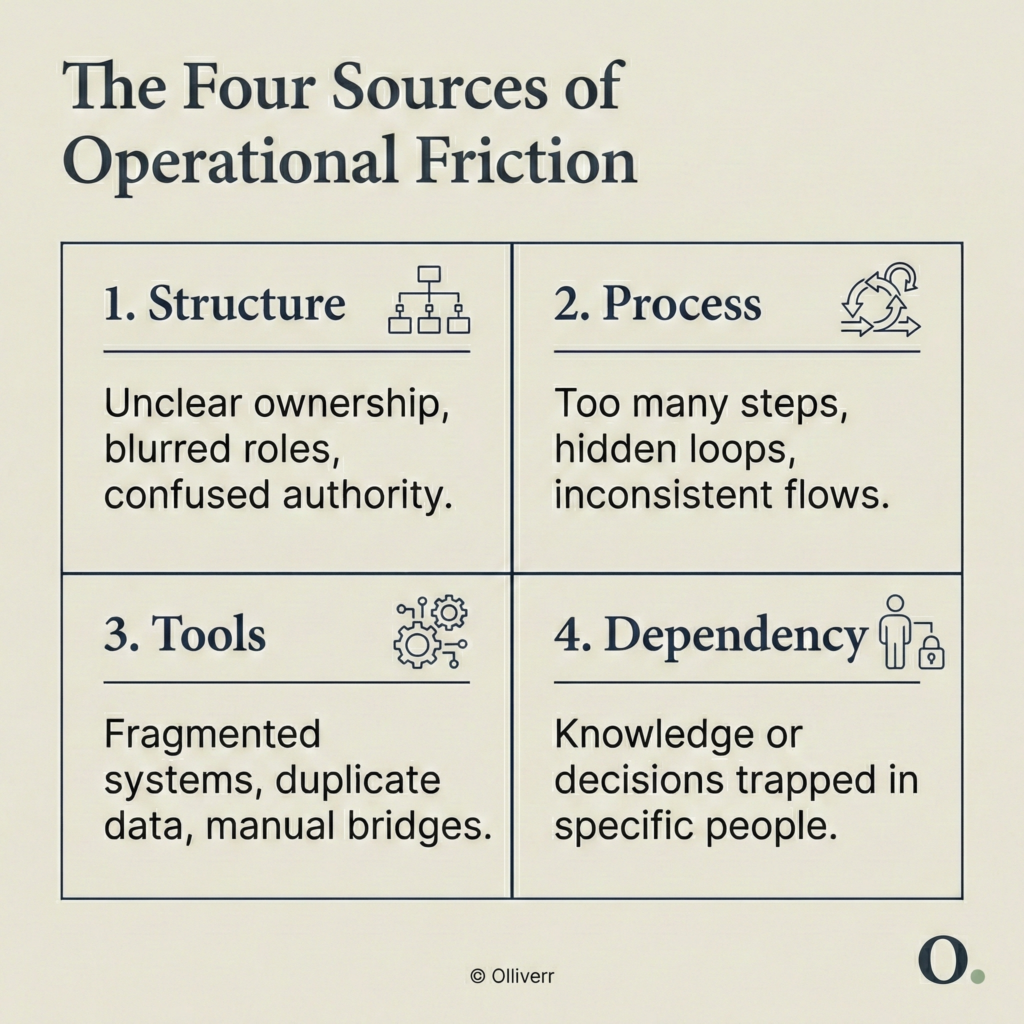
These aren’t separate problems. They often overlap. But almost every issue can be traced back to one of them.
Structure defines who owns what.
When structure is unclear, decisions float around waiting for approval. Work gets duplicated. Small issues get escalated. People hesitate because no one is sure what they’re allowed to decide.
You’ll hear phrases like:
- “I thought they were handling that.”
- “Let me just check with…”
- “We normally run it past the founder.”
Typical signs
- Overlapping responsibilities.
- Endless approvals.
- Escalations for small decisions.
- Managers acting as message relays.
When structure is clear, decisions happen closer to the work and noise drops.
Process is the path work takes from start to finish.
Poor processes usually look like extra steps that don’t add value, work moving backwards, people chasing updates, and each team doing things slightly differently.
Often, the process grew organically. No one designed it. It just accumulated.
Typical signs
- Tasks sitting in inboxes.
- Work bouncing between teams.
- Repeated corrections.
- Clients being asked for the same information twice.
Good processes are short, predictable, owned, and easy to explain.
If it takes ten minutes to describe a process, it’s probably too complex.
Tools should support the structure and process. Instead, many businesses end up with multiple systems doing the same job, data copied between tools, and people acting as the integration layer.
The result is more admin, more confusion, and less visibility.
Typical signs
- The same data entered in two or three places.
- Work tracked in spreadsheets outside the main system.
- Heavy reliance on email or chat to move work forward.
- No single source of truth.
Most teams don’t need more software.
They need fewer handovers between systems.
Dependency is where value lives inside individuals instead of the system.
This often shows up as one person who knows how everything works, one person who handles all escalations, or one person who approves every exception.
At first it feels efficient. Over time it becomes a bottleneck.
Typical signs
- Work stalls when one person is away.
- Decisions pile up in one inbox.
- The founder is copied into everything.
- No one feels confident acting without permission.
A business that depends on individuals will always feel tense.
A business that depends on structure feels calmer.
How these sources interact
These four areas are connected.
Poor structure creates unclear processes. Unclear processes lead to too many tools. Too many tools increase dependency on specific people who understand them.
If you only fix one area, drag often returns somewhere else. That’s why operational work should look at the whole system, not just symptoms.
A simple way to use this model
When something feels slow or messy, ask one question:
Which of the four sources is this really coming from?
- Is ownership unclear? → Structure.
- Are there too many steps? → Process.
- Are tools fighting each other? → Tools.
- Does everything rely on one person? → Dependency.
That single question usually brings more clarity than hours of meetings.
Closing
Operational drag isn’t random. It has a shape.
Most problems come from structure, process, tools, or dependency.
Once you can see which one you’re dealing with, the solution becomes more obvious and the business starts to feel lighter.
If you can name the drag, you can usually remove it.
And when the drag drops, the business gets lighter.