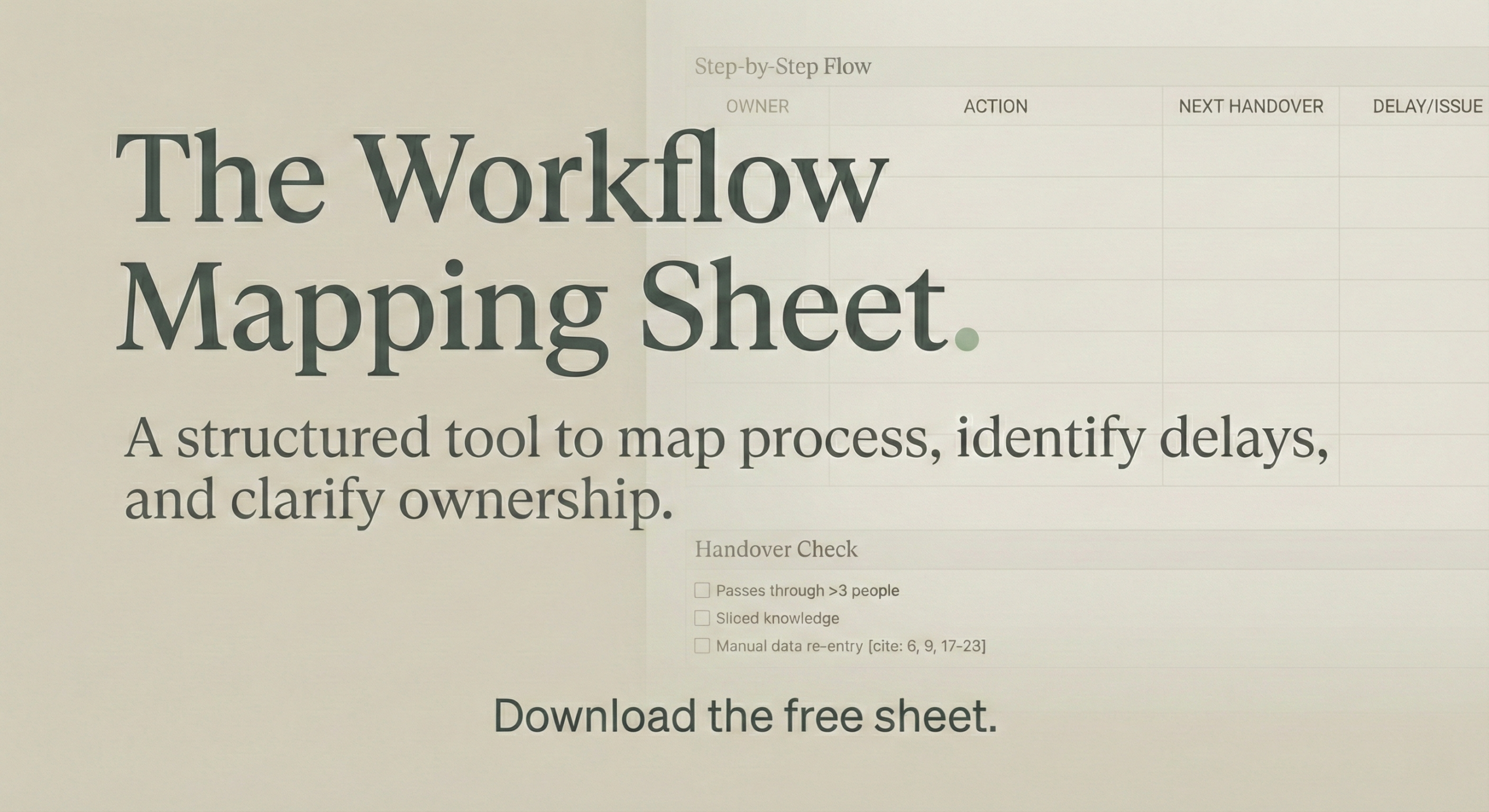
How to Map the Way Work Actually Flows.
How to map the way work actually flows, so you can spot handovers, delays, and unclear ownership before they turn into daily noise
How to map the way work actually flows
A simple guide to understanding what really happens inside your business
Most leaders think they know how work moves through their business.
They usually know the intention. They rarely know the reality.
“If five people describe the same process differently, that process isn’t a process. It’s folklore.”
This exercise isn’t about documentation for its own sake.
It’s about seeing where time leaks out, where ownership is unclear, and where work gets stuck in handovers.
You’re not redesigning anything yet. You’re just making the work visible.
Start small. If you try to map everything, you’ll produce a wall of boxes and learn nothing.
Choose one process that happens often and has consequences when it fails. Ideally something that touches clients, revenue, or delivery.
Good options
- Client onboarding.
- A service request from first contact to completion.
- Issue handling and escalation.
- Monthly invoicing and collections.
The goal is one clear map that tells the truth. You can repeat the exercise for other processes later.
Most internal maps start too late. They begin when someone logs something into a system.
Start where reality starts. The trigger event. The thing that causes work to exist.
Examples of real triggers
- A client email.
- A signed agreement.
- A phone call.
- A form submission.
If you begin in the wrong place, you’ll miss the hidden work. That hidden work is usually where delays and rework begin.
Now trace the work from start to finish. No tidy version. No “should.” Just what actually happens on a normal day.
For each step, answer three questions:
- Who does this?
- What exactly do they do?
- Where does it go next?
Write each step in simple terms. If you can’t explain it to a new hire without a ten-minute detour, the process isn’t clear.
Keep going until it’s genuinely finished. Not “handed off.” Finished.
A handover is any moment work moves from one owner to another. Person to person, team to team, or system to system.
Handovers are where work gets dropped, slowed, or distorted. They’re also where you find the “busy work” that exists purely to move information around.
What to mark on the map
- Every change of ownership.
- Every waiting point.
- Every time information is retyped or copied.
- Every “chase” for an update.
If you see the same information moving through multiple people before anything changes, you’ve found a structure problem.
Once the map is written, step back and look for patterns. This is the part that pays off.
Common patterns that create noise
- Work going backwards because something was missed.
- Approvals that add days but don’t add quality.
- People waiting because no one is allowed to decide.
- Work living in inboxes, DMs, or side spreadsheets.
Most delays aren’t caused by effort. They’re caused by unclear authority and too many handovers.
Now ask the uncomfortable question. For each stage, who owns the outcome?
Not who helps. Not who touches it. Who is accountable for it being done properly.
If your answers sound like this:
- “Everyone.”
- “Whoever is free.”
- “It depends.”
Then ownership isn’t clear, and the process will always feel heavier than it should.
Only after you’ve mapped the truth should you sketch a cleaner version.
A simple redesign usually means:
- Fewer handovers.
- Clearer ownership at each stage.
- Decisions made closer to the work.
- Less retyping, copying, and chasing.
This isn’t about making a perfect map. It’s about removing the obvious waste and making work easier to move.
If your “clean version” still relies on one person as the glue, that’s your real constraint.
Closing
If you don’t know how work actually flows, you can’t improve it with confidence.
You’ll hire, buy tools, and add meetings, and still feel the same drag.
Mapping creates a shared picture of reality.
Once you have that, redesign becomes straightforward. Less noise, fewer handovers, clearer ownership.